MyVipGuest vs HelloAgain: App-based vs App-less loyalty for Hotels
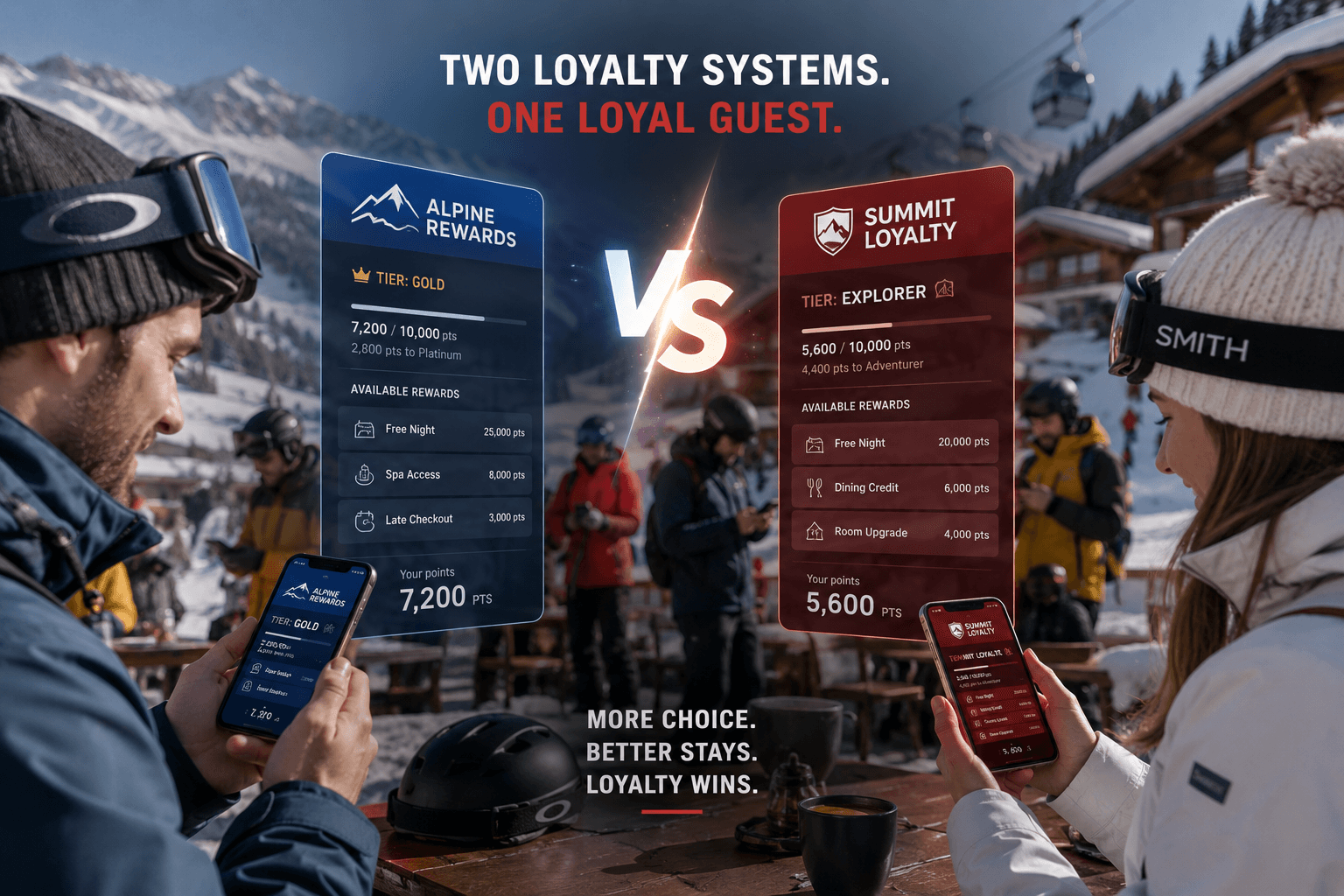
Choosing between an app-based and an app-less loyalty platform determines how many of your guests will participate in your hotel loyalty program - and how quickly you see revenue results. This comparison between MyVipGuest and HelloAgain examines two fundamentally different approaches to hotel guest loyalty programs: one that requires guests to download a dedicated guest app, and one that removes that barrier entirely through QR codes, web portals, and wallet passes.
Introduction
Choosing between an app-based and an app-less loyalty platform determines how many of your guests will participate in your hotel loyalty program - and how quickly you see revenue results. This comparison between MyVipGuest and HelloAgain examines two fundamentally different approaches to hotel guest loyalty programs: one that requires guests to download a dedicated guest app, and one that removes that barrier entirely through QR codes, web portals, and wallet passes.
This article is written for hotel GMs, revenue directors, and marketing teams at independent hotels, boutique hotels, and hotel chains evaluating loyalty software for their properties, including teams selecting among the best hotel loyalty programs for different property types. The distinction between app-based and app-less loyalty matters because 70% of guests abandon loyalty programs due to app download requirements - a friction point that directly impacts enrollment, guest retention, and repeat business. For hotels seeking to increase direct bookings and reduce OTA dependency, the loyalty platform you select shapes every downstream metric, with direct implications for hotel customer loyalty and guest satisfaction.
The core difference: MyVipGuest delivers a fully white-labeled, app-less loyalty experience where guests join, earn, and redeem rewards via QR codes and branded web portals - no download required. HelloAgain takes a mobile-first approach, building loyalty around a dedicated brand app that guests install to collect points, receive push notifications, and access loyalty benefits only after download and login.
By the end of this comparison, you will understand:
· Why guest adoption rates differ dramatically between app-based and app-less hotel rewards programs
· How operational complexity and implementation timelines compare between the two platforms
· What revenue impact each approach delivers for direct bookings, repeat stays, and ancillary spend
· Which technical integrations matter for property management system connectivity and real-time guest data
· How to choose the right loyalty platform based on your property type, guest demographics, and seasonal needs
Executive Summary: App-Based vs. App-Less Hotel Loyalty
· The Core Friction: Modern hospitality data shows that more than half of the guests abandon hotel loyalty programs due to app download requirements.
· The Solution: App-less loyalty platforms like MyVipGuest eliminate this entry barrier entirely, driving up to a 200% month-over-month increase in guest registration via instant QR codes and digital wallet passes.
· The Bottom Line: While app-based setups (like HelloAgain) suit high-frequency retail, app-less loyalty architecture delivers faster deployment and significantly higher direct booking conversions for independent, boutique, and chain hotels.
Why Guest Behavior Dictates Hotel Customer Loyalty Architecture
The hospitality industry faces a loyalty challenge that retail and e-commerce brands do not: hotel guests interact with your brand infrequently, often across different geographies, and their decision to return depends on whether they feel valued during a stay - not on whether they remember to open an app weeks later. This makes the delivery mechanism of your loyalty program as important as the rewards themselves, because the model you choose shapes how you build guest loyalty and create hotel customer loyalty over time.
App-Based Loyalty Program Mechanics
Traditional app-based hotel loyalty programs require guests to discover your app in an app store, download and install it, create an account, grant push notification permissions, and then actively use it throughout their stay. HelloAgain represents this model clearly - their platform centers on a branded mobile app where guests collect loyalty points, participate in challenges and games, receive push notifications, and redeem coupons and digital stamps.
The guest enrollment process in an app-based system introduces multiple friction points. Each step - from finding the app to completing registration to verifying an email - reduces conversion. For business travelers making a single stay or international guests unfamiliar with local app stores, this barrier is significant, especially because many customers prefer not to install a one-off hotel app for a single stay. Integration with hotel operations adds another layer: the app must sync in real time with your property management system and POS systems so that guest status, reward balances, and loyalty tier levels remain current when a guest checks in or orders at a restaurant.
Most loyalty programs built on app-first logic depend on push notifications to keep guests engaged between stays. But push permissions are declining industry-wide, and app-first models often struggle to engage guests when there is no immediate stay-related reason to open the app.
App-Less Loyalty System Operations
App-less loyalty systems operate through existing digital touchpoints that require no installation. A guest scans a QR code at the front desk, in their room, or at a restaurant table. They land on a branded web portal, enroll in seconds, and immediately see their rewards status. Alternatively, they click a link from a booking confirmation email or receive a digital wallet pass for Apple Wallet or Google Wallet.
MyVipGuest builds its entire loyalty platform around this principle. Guests participate via QR, web, or existing brand apps - fully branded under the hotel's name, logo, and color scheme. The guest never sees MyVipGuest branding. This white-label approach means your loyalty program looks and feels like a natural extension of your brand, not a third-party tool bolted onto your operations.
The operational integration is equally streamlined. QR-code enrollment can increase loyalty signups faster because there is no app store barrier, no account creation friction, and no compatibility issue across device types. For properties serving international guests at popular vacation destinations, this accessibility difference is not marginal.
The distinction between these models matters because hospitality guest behavior is fundamentally different from retail customer behavior. Hotel stays are episodic and low-frequency. Guests do not visit weekly. A loyalty program that depends on app engagement between stays - when the guest has no reason to open it - structurally disadvantages itself compared to one that activates at the moment of arrival, dining, or checkout, when app-less access can encourage guests to interact.
MyVipGuest vs. HelloAgain: Comparing the Best Hotel Loyalty Programs
Both MyVipGuest and HelloAgain serve businesses that want to build customer loyalty and achieve successful hotel loyalty through structured reward programs. However, they approach the hospitality market from different angles - one designed specifically for guest-driven businesses, the other originating as a broader loyalty platform adapted for multiple industries, making this comparison about two paths to a successful loyalty program in hospitality.
MyVipGuest Platform Overview
MyVipGuest is a bespoke loyalty ecosystem that combines loyalty, CRM, and guest engagement in one platform - fully white-labeled and built for hospitality operators. It is not a generic loyalty software tool. The platform rewards the specific behaviors that hospitality depends on: bookings, stays, repeat visits, spend, referrals, reviews, and social sharing, and is designed to enhance guest experiences across bookings, stays, spend, and post-stay advocacy.
The no-app guest experience eliminates the primary enrollment barrier. Guests join via QR codes at any touchpoint - front desk, table tents, in-room materials, receipts - or through branded web portals linked from booking confirmations. The entire experience runs under your brand identity. Fully white-labeled systems prevent third-party branding exposure, and custom domain mapping ensures guests interact with your domain, not a third-party URL.
MyVipGuest includes an AI-powered assistant that helps operators design loyalty models and generate vouchers - removing guesswork from program structure. AI-powered setup can launch white-label loyalty programs in days, not months, without requiring IT department involvement. Front desk and marketing teams manage everything from a unified dashboard.
HelloAgain Platform Overview
HelloAgain offers an app-based loyalty platform where businesses create a branded mobile app for their customers. That model is common across retail-style programs and some hotel brands, but it works best when operators can sustain strong ongoing app adoption. The app serves as the primary channel for point collection, reward redemption, and communication. Features include digital stamp passes, seasonal games, challenges, coupon management, and campaign automation. Communication tools span push notifications, email, and SMS, with segmentation capabilities and RFM analysis (recency, frequency, monetary value).
The platform provides analytics dashboards with loyalty statistics and frequency tracking. It supports customer data management and offers campaign automation for targeted messaging. HelloAgain's app is designed with the brand's visual identity, giving businesses control over look and feel within the app environment.
For hospitality clients, the implementation requires building or customizing a mobile app, submitting to app stores, managing cross-platform compatibility, and ensuring real-time synchronization between the app and backend systems; that is more typical of a hotel chain rollout than of a lighter-weight independent hotel deployment.
Guest Experience Comparison
The enrollment experience defines whether a loyalty program reaches a meaningful share of your guests and turns signups into repeat guests or remains a niche feature used by a small percentage.
Enrollment friction: With HelloAgain, a hotel guest must discover the app, download it from an app store, create an account, and grant permissions. With MyVipGuest, the same guest scans a QR code and enrolls on a branded web page in seconds.
Participation rates: More than half of travelers consider rewards crucial when choosing lodging, but they will only participate if the process is frictionless.
International guest accessibility: Hotels at popular vacation destinations serve guests from dozens of countries. App store regional restrictions, device compatibility issues, and language localization within a dedicated app create barriers that web-based enrollment avoids entirely. A QR code works on any smartphone, in any country, without app store access.
Reward visibility and redemption: Guests prefer instant perks during their stay, such as late checkout and room upgrades, over future rewards. MyVipGuest delivers reward visibility immediately through web portals and wallet passes. In app-based systems, if the guest does not open the app, rewards remain invisible.
Operational Implementation and Management Comparison
Operational simplicity determines whether your loyalty program becomes an active revenue driver or an underused system that staff avoid promoting. For hotels, the front desk team and marketing staff are the people who make loyalty work day-to-day - not IT departments.
Implementation Timeline and Complexity
MyVipGuest launches in days. The platform's AI-powered setup handles loyalty model design, brand customization, and deployment of QR and web access points. Pre-built connectors for major hospitality systems eliminate months of integration work. Full program activation, including multi-location setups, typically completes within 90 days for complex properties. For seasonal hotels that need a program live before high season, this speed is the difference between capturing this year's guests and losing them to OTAs, while helping hotels save both time and missed revenue opportunities.
HelloAgain follows a traditional app development timeline. App creation or customization, app store submission and approval, QA testing across iOS and Android, and backend integration all add up. Traditional mobile app development timelines force properties into extensive waiting periods before their platform goes live. For independent operators and boutique properties that rely heavily on peak seasonal travel windows, this lengthy technical delay means the loyalty program will not be functional during critical high-occupancy months. Consequently, justifying the upfront development friction becomes incredibly difficult for standalone hotels trying to remain competitive against international hotel chains.
IT requirements differ significantly. MyVipGuest is designed so front desk and marketing teams manage the platform without IT support. HelloAgain's app-based model introduces ongoing technical dependencies: app updates for new OS versions, app store compliance, push notification infrastructure, and cross-platform testing.
Daily Operations and Staff Management
For front desk teams, loyalty program value depends on how easily they can enroll a guest, recognize member status, and apply rewards. MyVipGuest integrates with the property management system so that PMS integration enhances guest recognition at check-in. Staff see loyalty tier, available rewards, and guest preferences within their existing workflow. Enrolling a new guest means presenting a QR code - no app installation assistance, no troubleshooting login issues, no explaining which app store to visit.
Marketing teams using MyVipGuest access real-time analytics that track loyalty ROI, redemption rates, and engagement with live dashboards. Campaign tools allow guest segmentation and tailored promotions based on loyalty data - booking frequency, spend patterns, referral activity. Loyalty programs can lower marketing costs by 5 to 7 times compared to new guest acquisition, but only if the marketing team can operate the system independently.
For multi-location management - hotel chains, resort groups, restaurant portfolios - MyVipGuest provides unified dashboard control across multiple venues, brands, and regions. Brand consistency, regional settings, and centralized reporting operate from one interface. App-based platforms managing multiple properties face additional complexity: separate app store entries, regional app versions, and fragmented data across installations.
Technical Integration Capabilities
The integration layer determines whether loyalty data flows automatically between systems or requires manual reconciliation.
PMS integration: Real-time data synchronization is crucial for loyalty programs. MyVipGuest connects with Opera, Cloudbeds, Protel, and other hospitality systems through pre-built connectors. Stay data, booking source attribution (direct vs. OTA), and guest profiles synchronize automatically. Effective loyalty software integrates with PMS for real-time data synchronization - without this, front desk staff cannot recognize members or apply tier benefits at check-in.
POS connectivity: Tracking guest spend across F&B outlets, spa, and activities requires POS integration. MyVipGuest captures ancillary spend to calculate loyalty rewards accurately, enabling reward structures based on total property spend rather than room bookings alone. HelloAgain's public documentation mentions data management capabilities but provides less clarity on ready-made POS connectors for hospitality environments, while visible earning logic can keep guests spending money across outlets because rewards are tied to total property spend.
CRM integration: Integration with CRM systems allows for personalized guest offers based on stay history, guest preferences, and spending patterns, with targeted messaging built around distinct guest segments without manual list-building. AI-powered tools enhance CRM integration for tailored experiences - MyVipGuest's AI assistant uses guest data to recommend voucher types, loyalty tier structures, and reactivation campaigns. Real-time analytics track loyalty ROI and engagement rates through live dashboards accessible to non-technical staff.
Google Reviews integration: MyVipGuest connects to your Google account and integrates reviews, creating a positive effect on ranking. Rewarding guests for leaving reviews ties your loyalty program directly to your hotel's reputation and online reputation, turning loyal customers into active brand advocates.
Key Differences at a Glance
- Guest onboarding
- MyVipGuest: Instant access via QR code, web, or Apple/Google Wallet—no app installation.
- HelloAgain: Requires guests to download a dedicated mobile app.
- Deployment speed
- MyVipGuest: Can be launched within days or weeks.
- HelloAgain: Typically requires several months due to app development and app store approval.
- Brand experience
- MyVipGuest: Completely white-labeled with no visible platform branding.
- HelloAgain: Branded app, but the underlying third-party framework remains visible in app stores.
- Hospitality integrations
- MyVipGuest: Native integrations with leading hospitality PMS systems (Opera, Cloudbeds, Protel) and real-time synchronization.
- HelloAgain: Offers CRM and analytics capabilities, though the extent of hospitality-specific PMS/POS integrations is less clearly documented.
- Loyalty mechanics
- MyVipGuest: Rewards a broad range of guest actions, including bookings, stays, spending, referrals, reviews, and social engagement.
- HelloAgain: Focuses on traditional loyalty mechanics such as points, stamps, challenges, gamification, and coupons.
- Multi-location management
- MyVipGuest: Centralized management across multiple properties, brands, and regions from a single dashboard.
- HelloAgain: Appears to support multiple locations, but separate app versions may introduce additional administrative complexity.
Revenue Impact and Performance Metrics Analysis
The financial case for a loyalty platform is straightforward: does it drive direct bookings, increase repeat business, and generate measurable ROI? The mechanism through which guests participate - app-based or app-less - directly affects every revenue metric because it determines adoption rates.
Direct Booking Performance
Transitioning guests from third-party distribution channels to your own engine is the fastest way to protect hotel revenue. Data from MyVipGuest deployments indicates that shifting to a frictionless loyalty model can boost direct bookings drastically. This shift acts as an immediate defense against high OTA commission margins, which traditionally drain revenue from a property’s bottom line with every booking. For an independent hotel or boutique resort generating 2 million euros in annual room revenue with a heavy reliance on third-party channels, migrating even a fraction of those guests to native reservation systems recovers tens of thousands of euros in captured margins.
MyVipGuest achieves this by integrating loyalty rewards with the booking engine. When a guest books directly, they earn rewards points automatically. The system differentiates booking channels via PMS integration, so only direct bookings trigger loyalty rewards - creating a clear financial incentive for guests to bypass OTAs. Loyalty programs reduce reliance on OTAs by incentivizing direct bookings through personalised rewards that guests cannot access through third-party platforms.
App-based loyalty programs can also reward direct bookings, but only if the guest has installed the app and is logged in during the booking process. If the loyalty flow requires opening an app, finding a booking feature, and completing a reservation within that app, conversion rates typically decline compared to web-based flows.
Guest Retention and Repeat Business
Loyal guests typically spend 23% more during their stays than first-time visitors. Increasing your repeat guest rate by even a modest percentage compounds this spending advantage across every return visit.
MyVipGuest reports a higher improvement in repeat stay rates for hotels using its platform. This improvement comes from several mechanisms: early reward delivery, which helps guests feel appreciated sooner instead of waiting for a distant redemption threshold, referral incentives that bring new guests who are already pre-qualified through word-of-mouth, and review rewards that keep the hotel visible in search results.
The adoption barrier of app-based programs directly suppresses repeat business metrics. If a guest enrolls during their first stay but uninstalls the app before their next trip, they have no connection to the program. Web-based and wallet pass loyalty maintains passive visibility - a pass sitting in Apple Wallet or a saved web link in email requires no active maintenance from the guest.
Personalized interactions lead to higher guest retention rates. When your loyalty platform captures guest behavior - room preferences, dining choices, spa usage - and surfaces that data to staff at check-in, guests feel valued and appreciated. This kind of personalized recognition helps create emotional connections that drive repeat stays in ways generic or formulaic plans cannot replicate.
Ancillary Revenue Generation
Room revenue is only part of the picture. Spa bookings, restaurant spending, activity reservations, and gift shop purchases represent significant revenue that loyalty programs can influence. MyVipGuest's reward logic tracks spend across all outlets via POS integration, enabling reward tiers that incentivize total property spend, including experiential rewards tied to on-property activities.
Hotels with active MyVipGuest programs report that loyalty members generate higher ancillary spend because the rewards system is visible throughout the guest journey - at the restaurant, at the spa, at the activity desk. QR codes at each touchpoint remind guests that their spending earns rewards, creating a continuous loop of engagement and spending.
For resort groups and multi-property operations, cross-venue revenue tracking means a guest who stays at one property and dines at another earns rewards across both - encouraging exploration of the full portfolio. Real-time voucher systems allow marketing teams to create flash promotions (a complimentary welcome drink for loyalty members dining tonight, a free room upgrade for guests booking a spa treatment) that act as exclusive perks during the stay rather than delayed rewards, driving immediate ancillary revenue.
Common Implementation Challenges and Solutions
Loyalty program failure in hospitality is rarely a technology problem. It is an adoption and connection problem. Most hotels do not fail because they lack loyalty software - they fail because their program is disconnected from how guests actually check in, refer friends, or redeem rewards.
Guest Adoption Friction
The challenge: 70% of guests abandon loyalty programs due to app downloads. For independent hotels and boutique hotels without massive brand recognition, asking a guest to install an unknown app is a particularly steep ask. International guests face additional barriers: unfamiliar app stores, limited device storage, and reluctance to grant permissions to apps from brands they have visited once.
The solution: MyVipGuest's web-based approach eliminates app friction entirely. A guest scans a QR code, lands on a branded enrollment page, and joins in under 30 seconds. No download, no account creation complexity, no app store navigation. The principle applies directly to hospitality: reduce friction, and adoption scales.
Staff Training and Operational Complexity
The challenge: Complex app-based systems overwhelm front desk teams. When staff need to troubleshoot app installations, explain login procedures, reset passwords, and manage push notification issues, loyalty promotion becomes a burden rather than a natural part of the guest experience. Staff stop mentioning the program, and enrollment stalls.
The solution: MyVipGuest is designed so front desk teams need only one action: present a QR code or mention the web portal. Guest recognition happens automatically through PMS integration - the system surfaces member status, tier level, and available rewards when a guest checks in. Voucher redemption is handled digitally. Marketing teams create campaigns, segment existing guests, and launch tailored promotions without technical assistance. AI-powered tools enhance guest personalization and loyalty rewards by automating model design and voucher generation.
Brand Consistency and Control
The challenge: Third-party app branding dilutes the hotel experience. When guests download an app that carries visible third-party framework elements - or when the app store listing reveals the platform vendor - it undermines the perception of an exclusive, property-specific program, especially because guests are more responsive when membership feels tied to exclusive benefits from the property itself. For boutique hotels and luxury brands where brand identity is a core differentiator, this exposure is unacceptable.
The solution: White-label loyalty solutions enhance brand identity for hotels by ensuring every guest touchpoint carries only your branding. MyVipGuest's fully white-labeled platform runs entirely under your brand name, logo, domain, and color scheme. Guests never encounter platform branding. Custom domain mapping ensures even the URL reinforces your identity. This consistency across the guest journey - from enrollment to earning to redemption - builds the kind of brand trust that creates loyal customers, encourages guests to return, and helps create hotel customer loyalty by making the program feel native to the brand.
Tailoring Your Loyalty Strategy: Property Type and Guest Demographics
The ideal loyalty software architecture depends heavily on your specific property type and guest dynamics:
· Independent and Boutique Hotels: For properties relying on unique guest experiences and high emotional connection, app-less loyalty platforms are crucial. They preserve 100% white-label brand consistency without forcing a casual, design-conscious visitor to download a single-use utility app.
· Resorts and Vacation Destinations: High international guest mixes mean app-store country restrictions and roaming friction can cripple sign-ups. Web-based QR enrollment and Apple/Google Wallet integration bypass these localized device barriers instantly.
Conclusion and Next Steps
App-based loyalty programs create structural adoption barriers that most hotel guests will not overcome. App-less loyalty, as delivered by MyVipGuest, removes that friction and replaces it with instant, branded participation through QR codes and web portals. Reflect what happens when a loyalty program matches the reality of hotel guest behavior, especially when visible rewards such as free nights or on-stay perks make lower-friction participation feel immediately worthwhile rather than fighting against it.
To determine which approach fits your property:
1. Assess your guest demographic: Do your guests visit frequently enough to justify an app, or are they seasonal visitors and international travelers who need instant, frictionless enrollment? Frequent-stay audiences may compare your offer with familiar benchmarks such as Marriott Rewards or Best Western Rewards, while occasional travelers may simply want instant participation.
2. Calculate your OTA dependency:
3. What percentage of bookings come through OTAs, and how much can an increase in direct bookings save you in commissions?
4. Evaluate your operational capacity: Can your front desk team manage a complex app-based system, or do you need a platform that works with a QR code and a dashboard?
5. Consider your timeline: Do you need a program live before your next high season, or can you wait 6–12 months for app development?
Ready to eliminate app-download friction and maximize your direct bookings? Book your personalized MyVipGuest demo today.
For properties already exploring loyalty infrastructure, related areas worth evaluating include PMS integration depth for real-time guest recognition, AI-powered marketing automation for guest reactivation campaigns, and referral program structures that drive new guests through your most loyal customers.
Frequently Asked Questions about Hotel Loyalty Programs
What is the main difference between app-based and app-less hotel loyalty programs?
The core difference lies in guest accessibility and enrollment friction. App-based platforms require guests to find, download, and log into a dedicated smartphone application from an app store before accessing rewards. App-less loyalty platforms, like MyVipGuest, eliminate this download barrier entirely by allowing guests to register instantly via web portals, on-property QR codes, or digital wallet passes like Apple Wallet and Google Wallet.
Why do app-less loyalty systems achieve higher enrollment rates?
Industry statistics show that 70% of hotel guests abandon loyalty programs if they are forced to download a dedicated mobile application. App-less platforms generate up to a 200% month-over-month increase in new member registrations because they work on any smartphone without installation, making them highly accessible for international travelers, seasonal visitors, and short-stay leisure guests.
What technical integrations are required to run an app-less loyalty system efficiently?
To recognize members and track total property spend accurately, a loyalty platform needs real-time synchronization with core hospitality software. Effective platforms provide pre-built connectors to integrate seamlessly with standard Property Management Systems (such as Opera, Cloudbeds, and Protel) and Point of Sale (POS) systems, ensuring guest tier data and ancillary revenue metrics flow automatically without manual tracking.